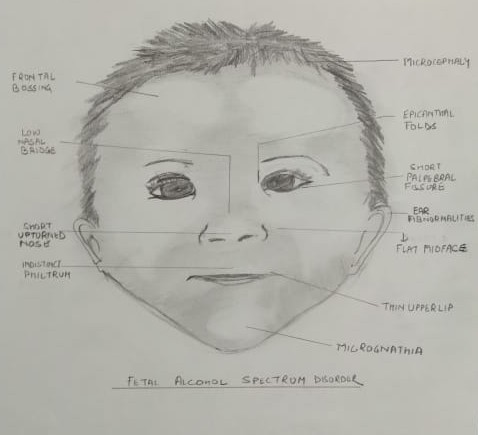
Unborn slaughter (Infanticide) seeks no repentance.More so subjecting an unborn to one’s addiction is still a greater sin that has no absolution. Fetus is very sensitive to substance abuse due to its underdeveloped metabolism and inability to eliminate them.As a results of this, substances continue to magnify and concentrate to toxic level leading to permanent damage of developing fetus. Adding to the devastating effects are the withdrawal symptoms for the new born child.
Fetal Alcoholic Syndrome(FAS) or Fetal Alcoholic Spectrum Disorder(FASD) is caused by the mother’s consumption of alcohol during pregnancy.There is no safe dose of alcohol consumption and facial anomalies associated during pregnancy is directly proportional to type of substance, time of consumption and number of time consumed.
Prevalence of FASD is 10 per 1000 in USA. Almost 68-89 per 1000 in South Africa .WHO says that 1 per 100 people has fetal alcohol spectrum disorder.Only about 10 percent of children with FASD show visible sign. Consumption of alcohol among Indian woman accounts for 5.8 percent in general population. The prevalence is almost 28-48 percent for higher risk group namely woman of low socioeconomic status, tribal woman, commercial sex workers and those belonging to upper rich class.
Lemoine and his associates in 1950 successfully linked fetal growth deficiency and mental retardation to maternal use.The results on the embryo is disruptive with a range of teratogenic and neurotoxic effects.The effects in the first week of embryogenesis are mainly on the craniofacial and skeletal midline and has a direct bearing on the mesodermal differentiation of periocular, nasal and odontogenesis. Last week of embryogenesis shows apoptosis of neurons, agenesis of corpus callosum in brain ,glial migration and diminished white matter causing disfunction of nervous system, cognitive deficit, attention deficit(48% with ADHD), executive functioning deficit, psychomotor disturbances affecting behaviour and learning ,language and speech primarily.
Cardiovascular, skeletal and cutaneous abnormalities are common.Congenital atrial and ventricular valve defect; renal and genital infection; peripheral and central hearing disorder. Cutaneous manifestation includes myopia, strabismus, telecanthus(increase distance between eyes) and microphthalmia(one or both of the eyeballs small), short palpebral fissure(narrow opening of eyelids),short upturned nose, accentuated saddle nose, long thin upper lip, thin vermilion border, lack of cupid’s bow and smooth philtrum, clinodactyly(curving of fingers), camptodactyly(one or more fingers permanently bent) small hands with characteristic palmer creases(hockey stick crease).
Children with FAS present with low weight, small size at birth ,sutural growth deficiency leading to microcephaly(small head), frontal bossing, maxilla retrusion, micrognathia(small lower jaw), maxillary hypoplasia(small upper jaw) and collapsed midface. Hypertrophy of adenoids, sleep apnoea and mouth breathing due to low tongue posture and vestibular dysfunction.High rate of non nutritive sucking causing inclination of labial incisor, counter clockwise tilting of palatal plane and characteristic large gonial angle.Asymmetry of upper and middle third of craniofacial complex ,high prevalence of TMJ disorder, dentofacial anomalies with crowding of incisors, diastema, maxillary and mandible overjets and openbites. Amelogenesis (developmental defect of enamel) is severely affected with enamel opacities and enamel hypoplasia (characteristic biomarker of intrauterine disturbance in first year of life).
Orthodontic intervention is difficult due to hyperactive behaviour and non compliance to removable appliance. Enamel hypoplasia triggers plaque accumulation, increase gingival and periodontal diseases, increases decay rate and unattended decay leads to chronic infection and dentoalveolar abscess which becomes difficult to manage and requires behaviour modification by a pediatric dentist.
Children of Fetal alcoholic syndrome needs to be recognised in a developing country like India where it emerges as increasing problem and steps should be taken in direction to manage important and potentially preventable oral and dental needs by initiating a national plan through trained dental staff.
 GAMEFACE